AI & Clean Energy: The UK's Ambition Dilemma
As artificial intelligence grows rapidly across the economy, the data centres powering it are placing unprecedented new demands on Britain's energy system, while Clean Power 2030 targets are fast approaching.
The Ambition
The UK government's AI Opportunities Action Plan, published in January 2025, positions AI as potentially the single biggest lever available to deliver its five national missions: Growing the economy, an NHS fit for the future, safer streets, opportunity for all, and making Britain a clean energy superpower.
A Quacquarelli Symonds 2026 report (in collaboration with Public First and the University of York) finds that through AI-supported augmentation and upskilling, increasing adoption could add up to £490 billion to the UK economy by 2030.
As the third largest AI market in the world behind the US and China, the UK faces a significant and growing energy demand underpinning that ambition. How the UK manages that demand alongside its clean energy commitments is an increasingly pertinent question, which this article explores.
A Demand Curve on the Move
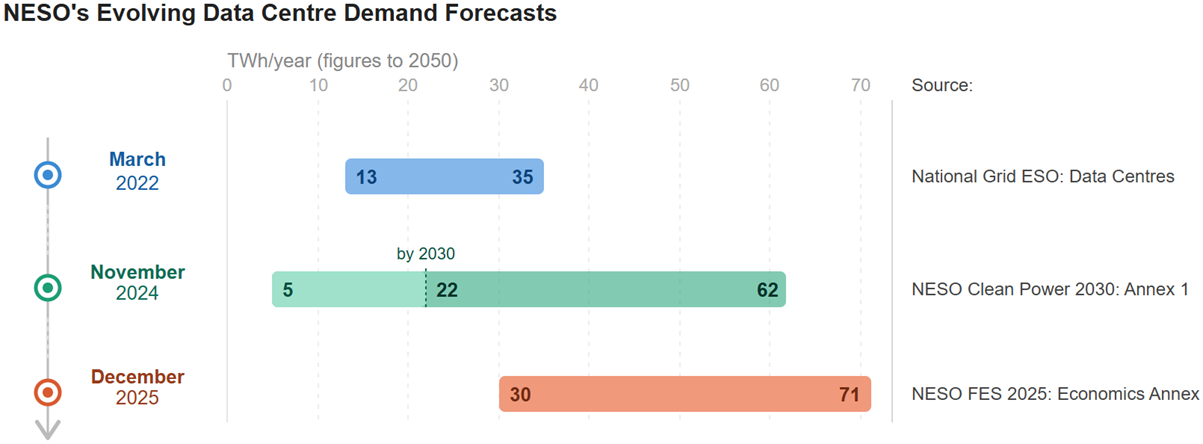
Energy demand from data centres is growing faster than forecasters have been able to predict.
The table here shows how dramatically NESO’s (and its predecessor, National Grid ESO) own projections have shifted over the last few years
To put the expected 2030 demand figure in context, the UK generated 285 TWh of electricity in total in 2024, meaning data centres consuming 22 TWh annually by 2030 represent around 8% of current national generation.
As NESO's Clean Power 2030 plan directly notes, 22 TWh is based on planning and grid connection applications already in the system, likely making this a low estimate.
A critical question this raises is whether the energy powering these data centres will be clean. The government's Clean Power 2030 target commits Britain to clean sources providing at least 95% of generation, with carbon intensity falling from 171g CO₂e per kWh in 2023 to below 50g by 2030.
NESO’s Modelling
NESO determine it remains achievable even if data centre demand quadruples, but only if transmission network build rates double and regional power networks expand four times faster than they have over the past decade.
Beyond 2030, the picture is less clear. This was highlighted by a parliamentary submission by Opportunity Green and Foxglove to the Environmental Audit Committee.
The Seventh Carbon Budget, which governs the legally binding period from 2038 to 2042 (when NESO predicts peak data centre energy demand), contains no reference to data centres.
For an infrastructure category set to consume an ever-growing share of national electricity, that is a notable gap in the policy framework.
Policy and Pragmatism
In September 2024, data centres were designated as Critical National Infrastructure, giving the sector prioritised government support during emergencies and signalling its strategic importance to the UK economy.
This is being backed by action with AI Growth Zones (AIGZs) being established across the country to fast-track planning and streamline grid connections for new facilities.
With clean power as an equally explicit priority, the question of what fills the energy gap is a live debate, and there is political pressure, particularly from the right, to turn to gas to bridge this gap quickly.
However, this raises tension for Energy Secretary Ed Miliband, who is committed to both the government's Clean Power 2030 target and its longer-term Net Zero 2050 obligations.
Miliband argues that clean energy is now the cheapest source of new electricity capacity in the UK and holds greater long-term security. While that argument is sound, it is dependent on transmission lines, offshore wind connections and grid upgrades being delivered at a speed the UK has not previously achieved.

The Power of AI
Although AI's energy demands are significant, the technology is also generating advanced tools for managing them.
Two finalists in the government's Manchester Prize, a £1 million competition for AI breakthroughs in clean energy, directly illustrate this.
Kestrix uses AI-powered thermal drones to map heat loss across entire neighbourhoods from the air, giving councils and housing providers rapid assessments of which properties need urgent retrofitting.
In a country where millions of homes still rely on gas heating, the ability to identify and prioritise planning at scale could be transformational.
Balancing a grid increasingly dependent on wind and solar, which cannot be switched on and off freely, is one of the clean power transition's harder engineering challenges.
The University of Manchester's Grid Stability Monitor tackles this directly, using machine learning to assess grid stability in real time as more variable renewable sources come online.
As Miliband summarised:
“Clean power is the economic opportunity of the 21st century and these projects will help households and businesses take advantage of lower bills, in a smarter and faster way than ever before”.
The question is whether the resource demands of AI infrastructure can be managed carefully enough to allow these benefits to be realised.
The Dilemma in Summary
The UK's AI and clean energy ambitions are not inherently incompatible. NESO's modelling suggests clean power by 2030 remains achievable even under the most demanding data centre growth scenarios, provided the grid is built at an unprecedented pace.
The gaps in the current picture are nonetheless notable
Data centres do not feature in the Seventh Carbon Budget, the speed of demand growth has repeatedly outpaced official forecasts, and the possibility of returning to gas sourcing remains a strong, politically-fuelled possibility.
AI's potential to drive economic growth, improve public services and support the clean energy transition is tangible, but so is the risk that powering it undermines the environmental commitments it sits alongside.
While that is not a reason to slow either agenda, a resolution will require greater political cohesion and long-term ambitions that are pragmatically grounded.