Corporate Health Check: Benchmarking Corporate Integration of Climate and Nature
Today, many companies find themselves in a familiar cycle: Robust reporting on climate and nature impacts, yet limited evidence that these disclosures are translating into meaningful strategic action.
The challenge is not a lack of intent; it is the complexity of embedding environmental considerations across governance, operations, and decision-making processes while balancing competing business priorities.
The CDP Corporate Health Check (2025) provides a structured, evidence-based approach to assess how effectively organisations integrate climate and nature into their core business, offering a roadmap for credible transition planning.

Why Now?
The urgency of the climate crisis and accelerating nature loss is reshaping corporate expectations.
Investors, regulators, and stakeholders increasingly demand transparency on environmental risks and progress.
Yet, disclosure alone does not ensure readiness. Companies need to understand their actual performance, identify gaps, and prioritise interventions that drive real-world outcomes.
The CDP Corporate Health Check responds to this need by combining environmental data with a practical assessment framework, enabling organisations to benchmark themselves against peers and high-performing leaders.
In doing so, it reveals both strengths and blind spots in the integration of climate and nature considerations.
How it Works
The Health Check is not a compliance checklist. Rather, it is a diagnostic and decision-support tool.
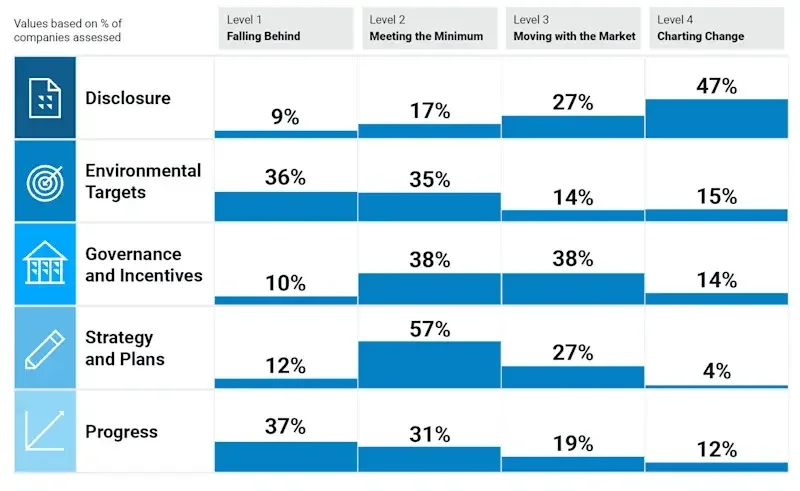
Using 2024 disclosure data from over 6,800 companies representing more than two-thirds of global market capitalisation, the framework evaluates corporate performance across five interconnected pillars: Disclosure, targets, governance, strategy, and progress.
Each pillar captures a dimension of organisational health, from transparency to implementation, providing a holistic view of how well environmental priorities are embedded into business models.
Companies are assessed across four levels:
- Level 1 - Falling Behind
- Level 2 - Meeting the Minimum
- Level 3 - Showing Ambition
- Level 4 - Charting Change
Only 10% of companies currently achieve Levels 3 or 4, demonstrating that meaningful climate and nature integration remains rare, even among the largest global corporations.
The Five Pillars
1. Disclosure
Disclosure is the foundation of environmental accountability. It involves reporting Scope 1, 2, and material Scope 3 emissions, as well as the company’s dependencies and impacts on nature, including water, forests, and biodiversity. Robust practice means full value chain transparency and clear articulation of material risks and opportunities.
Common gaps:
Many companies report only operational emissions (Scopes 1 and 2), with 45% not disclosing their most material Scope 3 emissions. Nature disclosure is similarly limited: only 64% report on water, and 46% on forest-related practices. Without comprehensive disclosure, boards and investors cannot make fully informed decisions.
2. Targets
Targets translate disclosure into ambition. High-quality targets cover the full value chain and relevant nature topics, are aligned with 1.5°C pathways or science-based standards, and include measurable metrics for water, biodiversity, and forests where material.
Common gaps:
While two-thirds of companies have set company-wide targets, only 33% extend targets across their value chain, and 40% address most of their material nature impacts. Ambitious target-setting signals readiness for credible transition planning and guides investment decisions.

3. Governance
Governance ensures accountability and integration of environmental priorities into decision-making. Strong practice includes board-level oversight, executive incentives linked to environmental targets, and robust internal structures for evaluating climate and nature risks.
Common gaps:
Many organisations lack clear linkages between executive performance and environmental outcomes. Only 8 in 10 frontrunners link executive pay to climate goals, highlighting the critical influence of incentives on driving meaningful action.
4. Strategy
Strategy embeds climate and nature considerations into core business planning, capital allocation, and risk management. Companies with mature strategies integrate environmental data into financial planning, investment decisions, and transition planning, including the development of 1.5°C-aligned climate transition plans.
Common gaps:
Less than half of companies globally have a transition plan, and only 9% align at least 5% of capital expenditure with these plans. Without this integration, sustainability remains peripheral to business operations, limiting long-term resilience.
5. Progress
Progress measures the translation of disclosure, targets, governance, and strategy into tangible outcomes. It captures reductions in emissions, improvements in biodiversity management, and other measurable impacts. High-performing companies track implementation over time and adjust course based on data-driven insights.
Common gaps:
Only 35% of companies are on track to meet their emissions targets, and progress on nature targets is even lower (22% for water, 15% for forests). This shows the need for continuous monitoring and course correction to achieve credible outcomes.

Transition Readiness
Benchmarking through the Health Check reveals where companies are falling behind, whether in disclosure, target-setting, governance, strategy, or execution.
By comparing performance against peers and frontrunners, organisations can identify priority actions, allocate resources effectively, and demonstrate to stakeholders that their environmental commitments are credible.
The Health Check provides a clear line of sight from disclosure to real-world impact, which is essential for effective transition planning.

Looking Ahead
As we enter 2026, corporate integration of climate and nature is becoming a determinant of resilience, competitiveness, and credibility.
Companies that embed these priorities across governance, strategy, and operations are better positioned to manage risks, seize opportunities in emerging green markets, and satisfy stakeholder expectations.
As environmental regulations tighten and capital markets increasingly reward sustainable performance, the ability to act on insights from a Corporate Health Check will distinguish leaders from laggards.
A Corporate Health Check offers more than a scorecard; it provides a practical, experience-driven lens to evaluate the depth and effectiveness of climate and nature integration.
By assessing disclosure, targets, governance, strategy, and progress, organisations gain an evidence-based view of their health, revealing both strengths and areas needing attention.
In the face of accelerating environmental challenges, this structured approach equips companies to move beyond reporting and toward credible, impactful action, aligning business success with the planet’s long-term health.